Saturday, January 17, 2009

ick bin ein lexikon

Languagehat recently posted about reading Döblin’s Berlin Alexanderplatz (link), and that got me to started wondering about the Berlin dialect. Long post short, I found a Berlinisch Lexikon online (link).

Labels: ,

Sunday, October 19, 2008

tags or elements

Finally a web-meme I can get into! Over at Mother Tongue Annoyances (a blog) I found the following meme (link) tacked on to the end of a funny rant on Henry “Dick” Miller:

A simple, two-step approach for generating your own, fully personalized, 21st century, Web 2.0-based reading list:

  1. Make a list of the top three books that have influenced your life, and make a note of the authors’ names
  2. Visit Literature-Map, plug each author name into the text box (one at a time, naturally) and generate a cloud of related authors. That ought to keep you busy for a while!

Thanks for playing. Have a nice day.

OK. Easy enough. My three life-changing books, off the cuff, were:

  • Voltaire, Candide. [map]
  • Joris-Karl Huysman, À Rebours. [map]
  • Aldous Huxley, Time Must Have a Stop. [map]

The first thing which struck me was the name juxtaposed to Voltaire’s, i.e., Scott Adams. In Paris, I once stayed at a hotel on the quai de Voltaire (across the Seine from the Louvre), and that key was named so because the building in which Voltaire spent the last years of his life and in which he died, then housed a café on its ground floor. I ate a lovely breakfast there, with strong coffee, croissant, and plum preserves. On the other hand, I once taught a Java class for a cohort of masters students from Pacific Bell, before it morphed into SBC and finally lapsed back into AT&T. Knowing that the author of Dilbert had worked there for years, I asked each student on the first night of class to introduce themselves, give any programming experience, and tell me the best story they knew about Scott Adams when he worked there. The only memorable story was that one of the students knew the woman engineer that the character Alice was based on. Go ahead and check out the maps for each of my three chosen authors. I did and enjoyed the fact that I had read works by about 50% of them.

Labels: , ,

Monday, March 31, 2008

certitudo indoctorum

It’s the sort of grammatical rule that’s easy to remember: use between with two conjoined noun phrases, but among with three or more. It also has nothing to do with English grammar or usage, but that does not stop the learnèd ignorant from foisting it upon you. It is an example of the etymological fallacy. Merriam-Webster’s Dictionary of English Usage (link) quotes J A H Murray (the first editor of the OED):

[Between] is still the only word available to express the relation of a thing to many surrounding things severally and individually, among expressing a relation to them collectively and vaguely.

The editors go on to say The OED shows citations for between used of more than two from 971 to 1885. 971 is the date the Bickling Homilies were composed (link). I took a look at the index. The entries for betweonum show that it is used four times as a postposition (probably more of a verbal particle), and a couple of times split with its complement coming between the two parts. For example:

þa cwædon þa apostolas to þæm folce, ‘Heo bið swiþor gestrangod be us tweonum þurh Drihtnes gehát’. p.143.ll.11f.

then said the Apostles to the people, ‘She shall be much more strengthened among us by God’s promise’.

In other words, pretty much since English has been written down, between has been used with more than three items.

Labels: ,

Sunday, March 16, 2008

mercutio florio

Years ago, while book-grazing at the local regional library facility, I came across a curious typescript called William Shakespeare, alias Mercutio Florio. Its title page indicated the author was Friderico Georgi, but in the card catalog this was said to be a pseudonym of Franz Maximilian Saalbach. It was published in Heidelberg in 1954. Googling Franz Saalbach dredges up a Heidelberger Geschichtsverein e.V. HGV history page (link) where 17. September 1952: Gründung der HIAG-Kreisgemeinschaft Heidelberg im Bergbräu, Hauptstraße 27. Zum ersten Sprecher wird Franz Saalbach gewählt.. The German Amazon lists the book, but there the author is Erich Gerwien (link). What triggered all of this was running across a theory that Shakespeare was Italian which a couple of Sicilian professors came up with (link). And, as with anything Shakespearean, can the Oxfordists be far off? This final bit is thanks to Languagehat (link).

Labels:

Thursday, August 30, 2007

coinkydinkies tween the blogosphere and meatspace

A while back, via the intertwingularity that is the very webbic essence of the blogosphere (probably, no doubt, via my good blogging buddy, Mr BaliHai of Eye of the Goof) I discovered Karl Esklund’s late-WW2 mémoir, My Chinese Wife. I saw a scan of the dust jacket, vide infra, which grabbed me by the lapels and said: go thou to Abebooks and buy this book, wait, and read it. Which I did. Had been waiting. After which I have done.

My Chinese Wife (partial)

Karl Esklund [1918–1972] leaves Denmark as a young man and travels to Shanghai where his dad is working as a dentist. He decides to make a living as a journalist, and soon falls for a Chinese woman, Fei Chi-yun [1918–2002], and woos and weds her, much to the chagrin of his father and hers. Adventures include getting out of war-torn Europe, trying to live in Chongqing [then known as Chungking], Chiang Kai-shek’s wartime capital of China. The story ends with Karl and Chi-yun going to Mexico via San Francisco with their newborn girl Mei-mei. The latter seems to have been a model for a Playboy newstand special The Girls of Playboy 2 (1974).

Labels:

Saturday, August 11, 2007

gripholdus knickknackius ex floilandia

All thanks be to Languagehat. Because of him, I have discovered a new (to me) blog: Varieties of Unreligious Experience. This is my kind of blog: well-written, quirky mini-essays on little known bits of letters and languages. For example, this entry about some strange varieties of Latin. Not your Cicerone’s classical Latin, not your Scaliger’s deracinated, humanist Latin, and not your father’s bog or kitchen Latin, but the over-the-top, outré Latin of the Hisperica Famina, of Vergilius Maro Grammaticus [fl. 658 CE], or of (my personal fave) Merlinus Coccajus ( Teofilo Folengo [1491–1544]). That’s the latter’s portrait, scanned from the frontispiece of Theophili Folengi vulgo Merlini Coccaii opus macaronicum notus illustratum. Cui accessit vocabularium vernaculum, Etruscum, et Latinum. Editio omnium locupletissima. Pars prima. Amstelodami. MDCCLXVIII.

coccajus

I’ve been a big fan of Macaronic poetry ever since running across a reference to it in Ernst Robert Curtius’ Europäische Literatur und lateinisches Mittelalter (1948). Inaugurated by Typhis Odaxius (or, Tifi Odasi) in his Macaronea and perfected by Folengo [1496–1544] in his sublime mock-heroic Baldus. Written in Latin hexameters, with überlatinifized vulgar-language words. Although, the term macaronic stems from the early 16th century, the tendency to mix languages in poetry has been around at least as early as Ausonius. Here’s a late 16th century German example:

Angla floosque canam, qui Wassunt pulvere svvarto,
Ex watroque simul stoitenti et blaside dicko,
Multipedes deiri qui possunt huppere longe,
Non aliter quam si flöglos natura dedisset.
Illis sunt equidem, sunt inquam corpora kleina,
Sed mille erregunt menschis matrasque plagasque,
Cum steckunt snaflum in livum blautumque rubentem
Exsugant; homines sic, sic vexeirere possunt!
Ex quæ tandem illis pro tantalonia restant
Vexeritate, et quem nemant pro vulnera lodum!
[Flöia, cortum versicale, de flôis schwartibus, illis deiriculis, quæ omnes ferè Minschos, Mannos, Vveibras, Iungfras, &c., behùppere, et spitzibus suis schnaflis steckere et bitere solunt, authore. Gripholdo Knickknackio ex Floilandia. Anno 1593. Via Carl Blümlein Die Floia und andere maccaronische Gedichte, 1900]
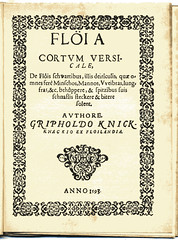
flohiada

This succulent post on palæological grammar has reminded me that I am still searching for a copy of Non olet; oder, Die heiteren Tischgespräche des Collofino über den orbis cacatus, nebst den neuesten erkenntnistheoretischen Betrachtungen über das Leben in seiner phantastischen Wirklichkeit erzählt von ihm selbst (1939) by Collofino [1867–1947].

Labels: ,